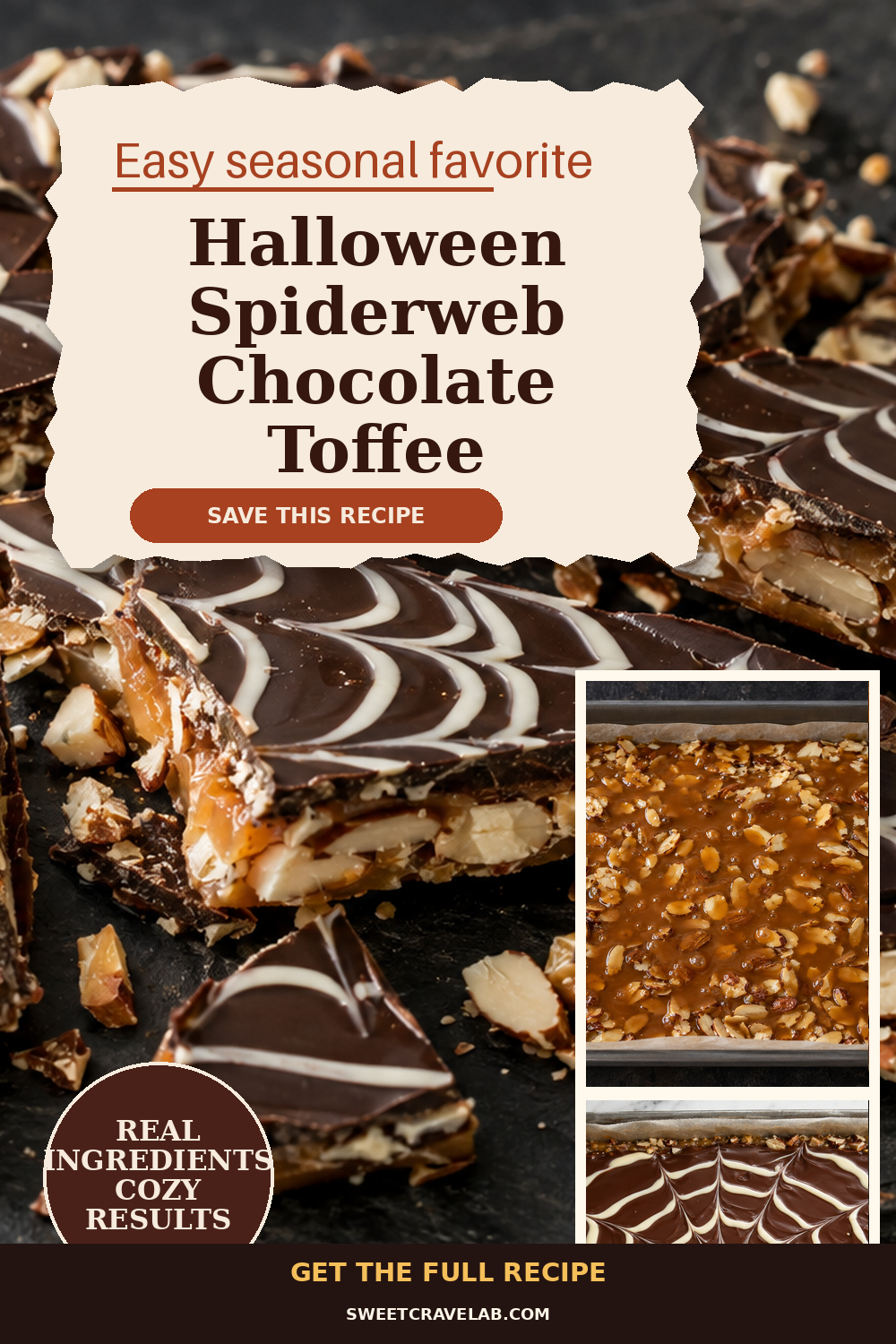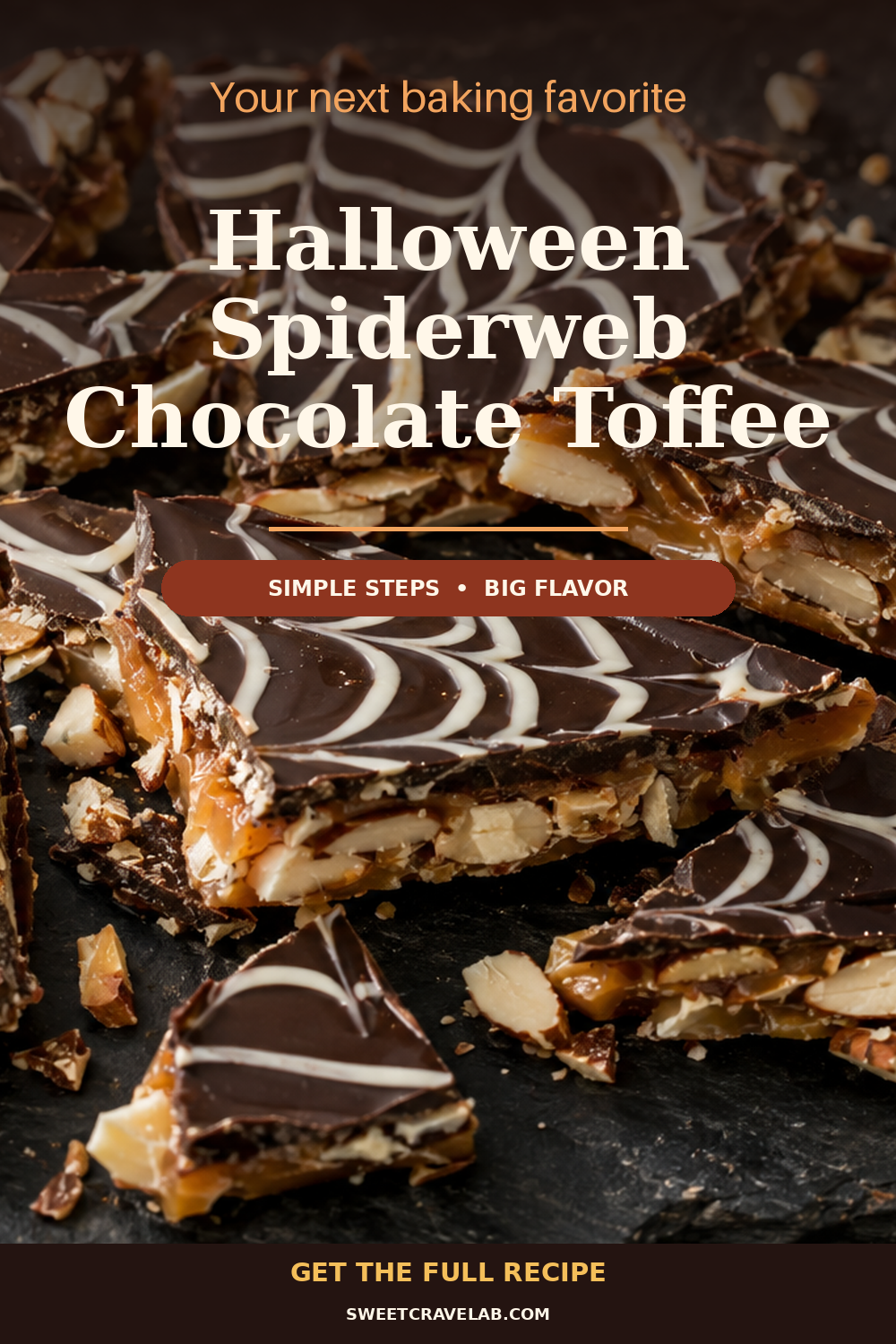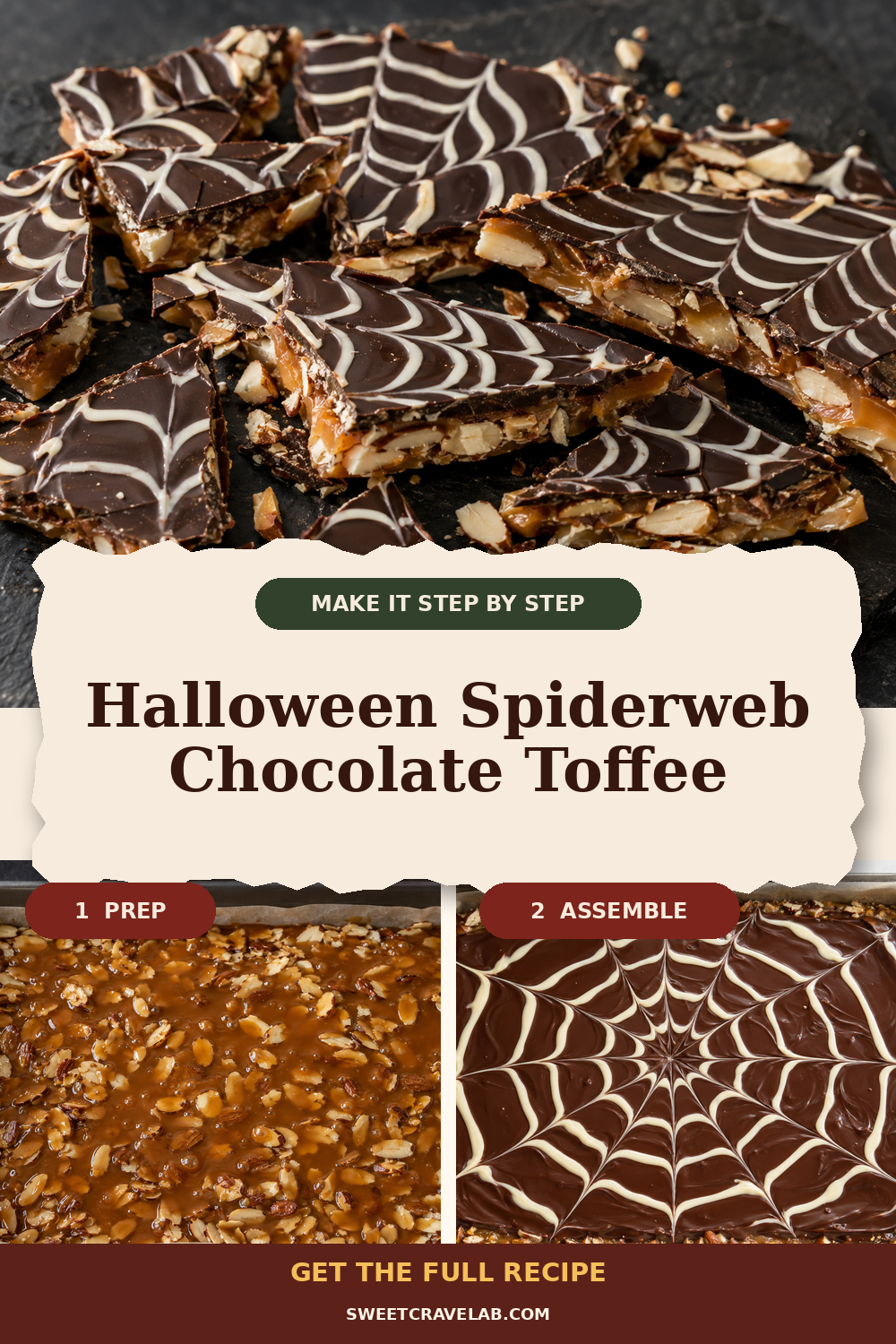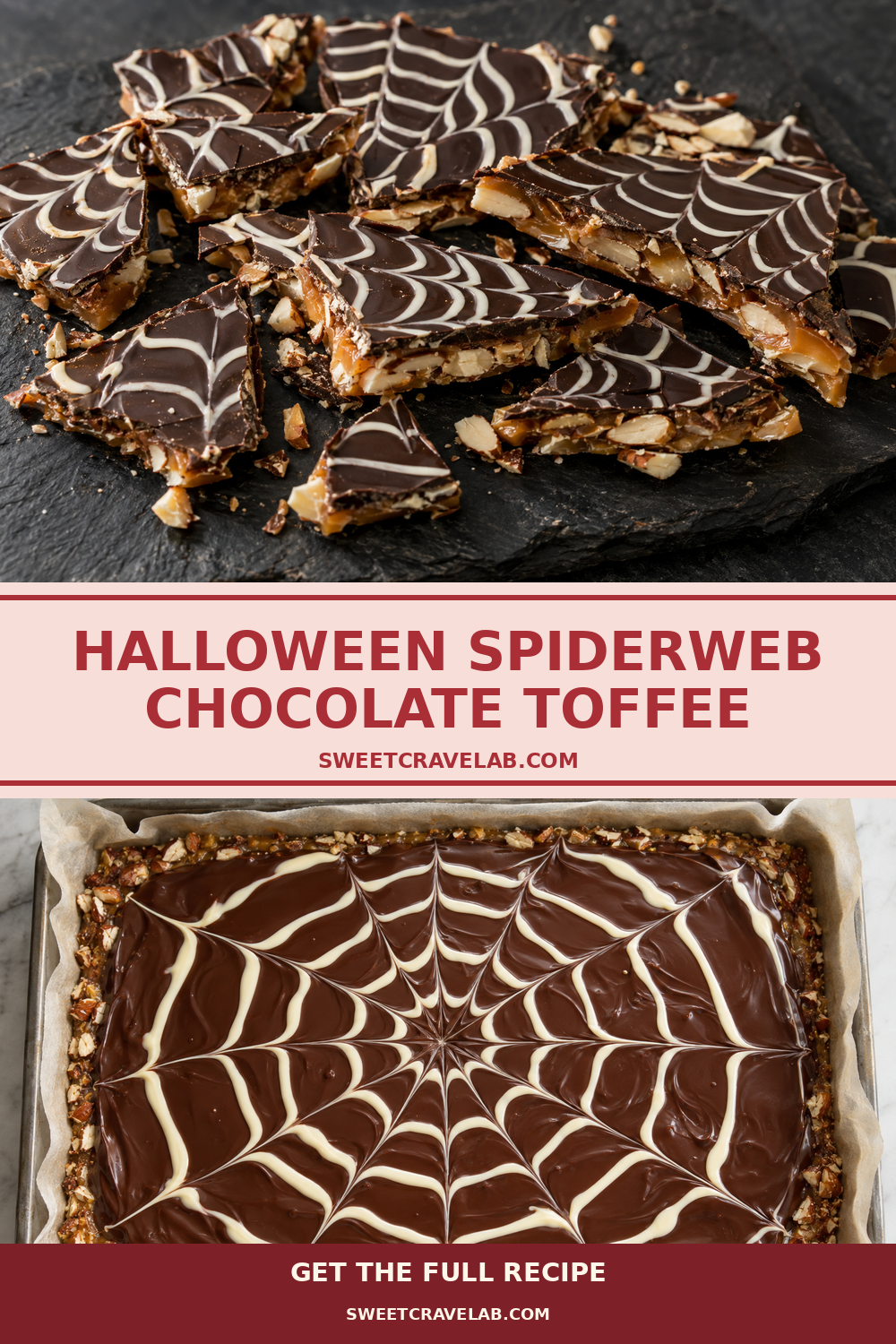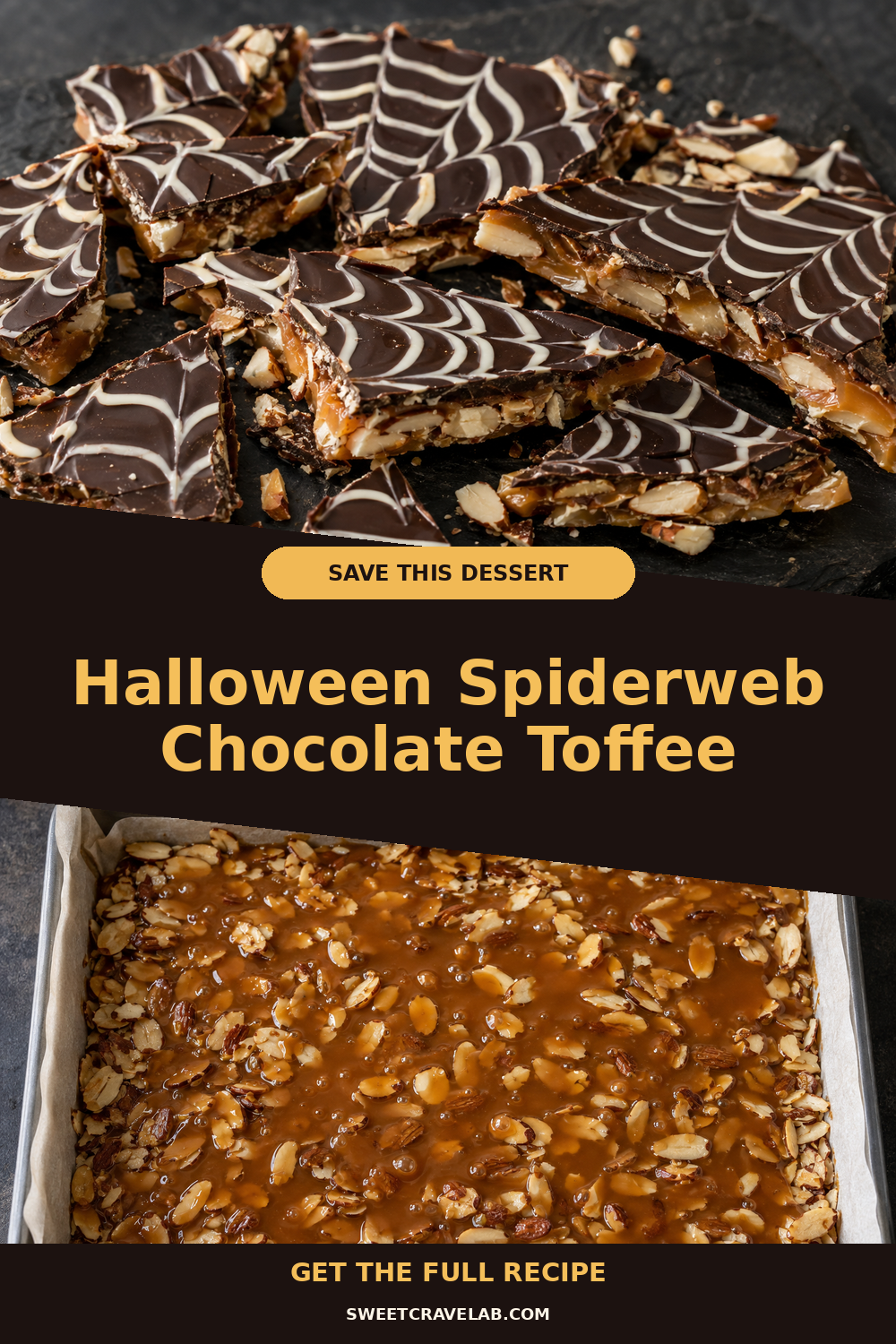
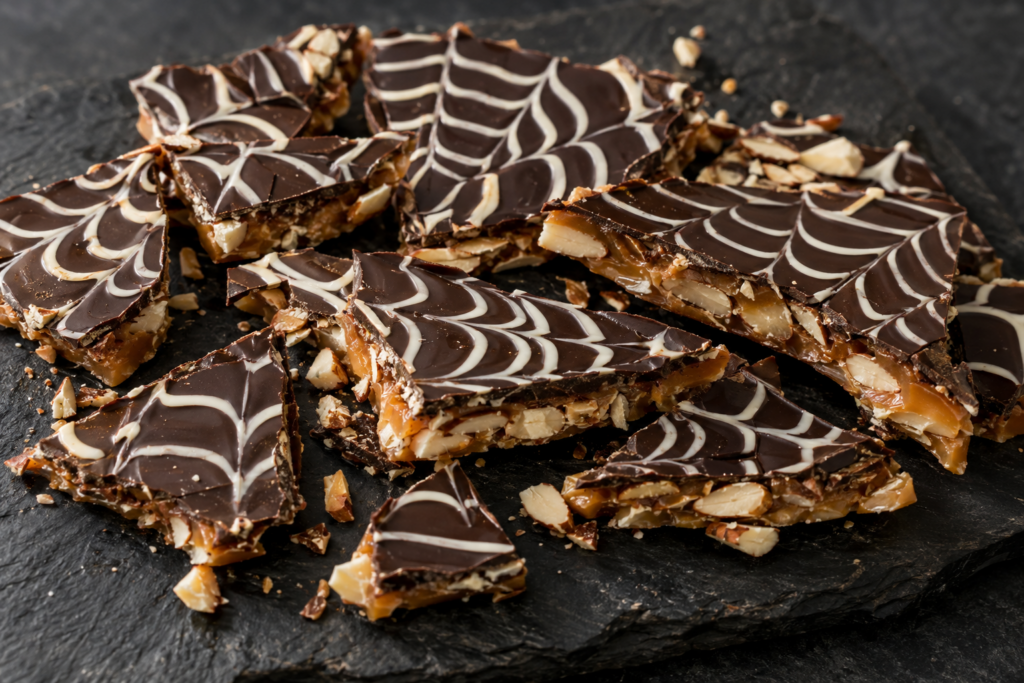
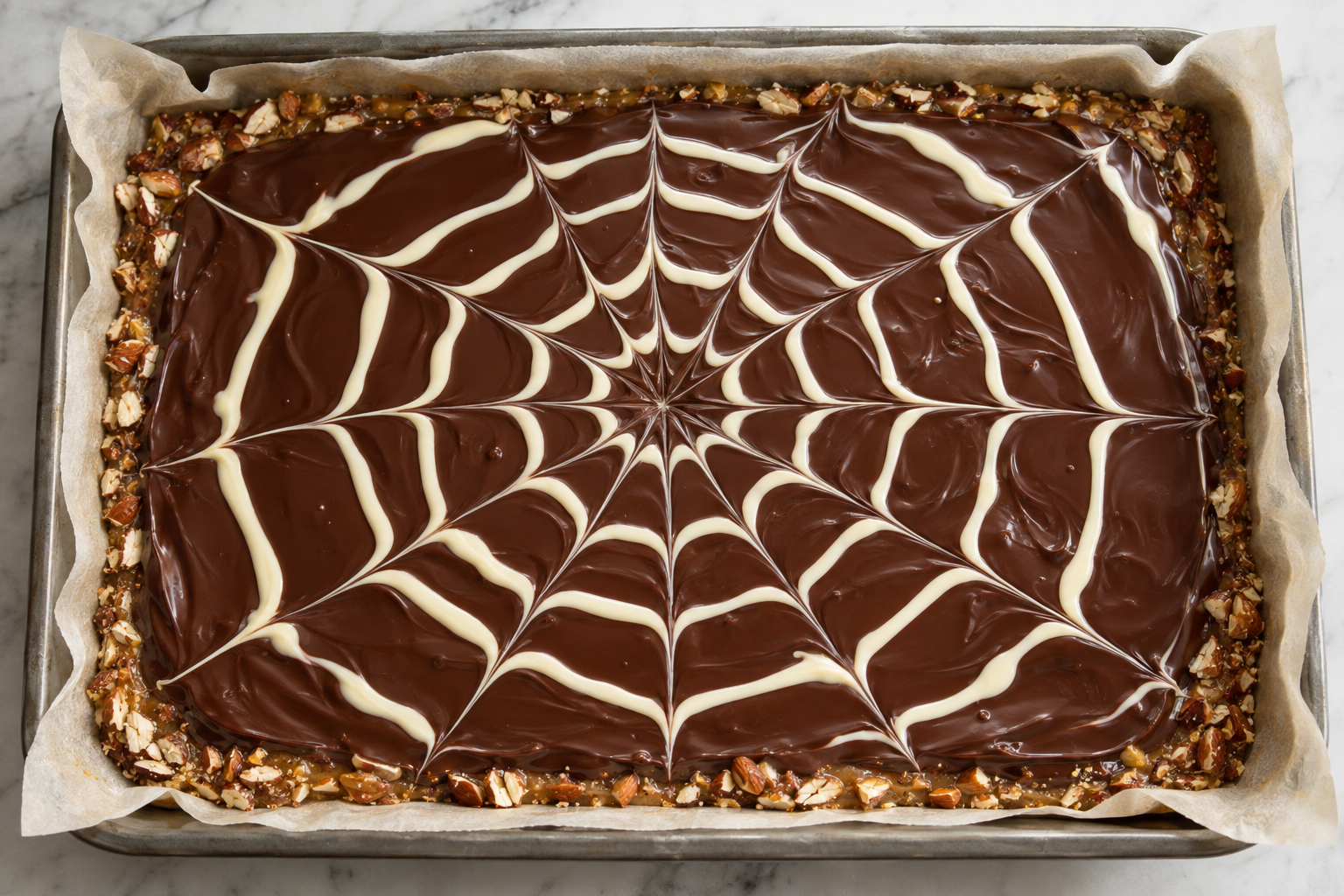
Desserts that look impressively “prepared,” even when they’re really just smart steps—this Halloween spiderweb chocolate toffee is exactly that: a single-pan butter–almond toffee, covered in dark chocolate, and then finished with a bold white-chocolate web you can pipe while the chocolate is still workable.
The secret to the crunch is the candy thermometer stage—when the toffee hits 300°F / 149°C, it sets up into crisp brittle once cooled. Then the design is surprisingly forgiving: the spiderweb lines should look glossy for a moment, then set fast when the room is cool.
Note: the images in this article are illustrative and meant to help you visualize each stage.
What makes this Halloween chocolate toffee “work”
This is a cooked toffee, not a quick stir-and-pour candy. Heating sugar with butter, corn syrup, and water cooks off moisture and concentrates the syrup. When it reaches the right temperature, it will cool into a crisp, snappy slab instead of chewy caramel.
- Temperature check wins: color can mislead you; use the thermometer.
- Two texture windows: dark chocolate should be set but still slightly pliable for clean spiderweb contrast.
- One pan, easy serving: bake, cool, slice—about 32 pieces.
Pan + setup (keep this consistent)
Use one 9×13 in (23×33 cm) parchment-lined pan for the whole batch. Parchment overhang makes lifting and slicing clean and keeps the toffee from sticking.
Method overview (quick map)
- Cook toffee: heat butter, sugar, corn syrup, water, and salt to 300°F / 149°C.
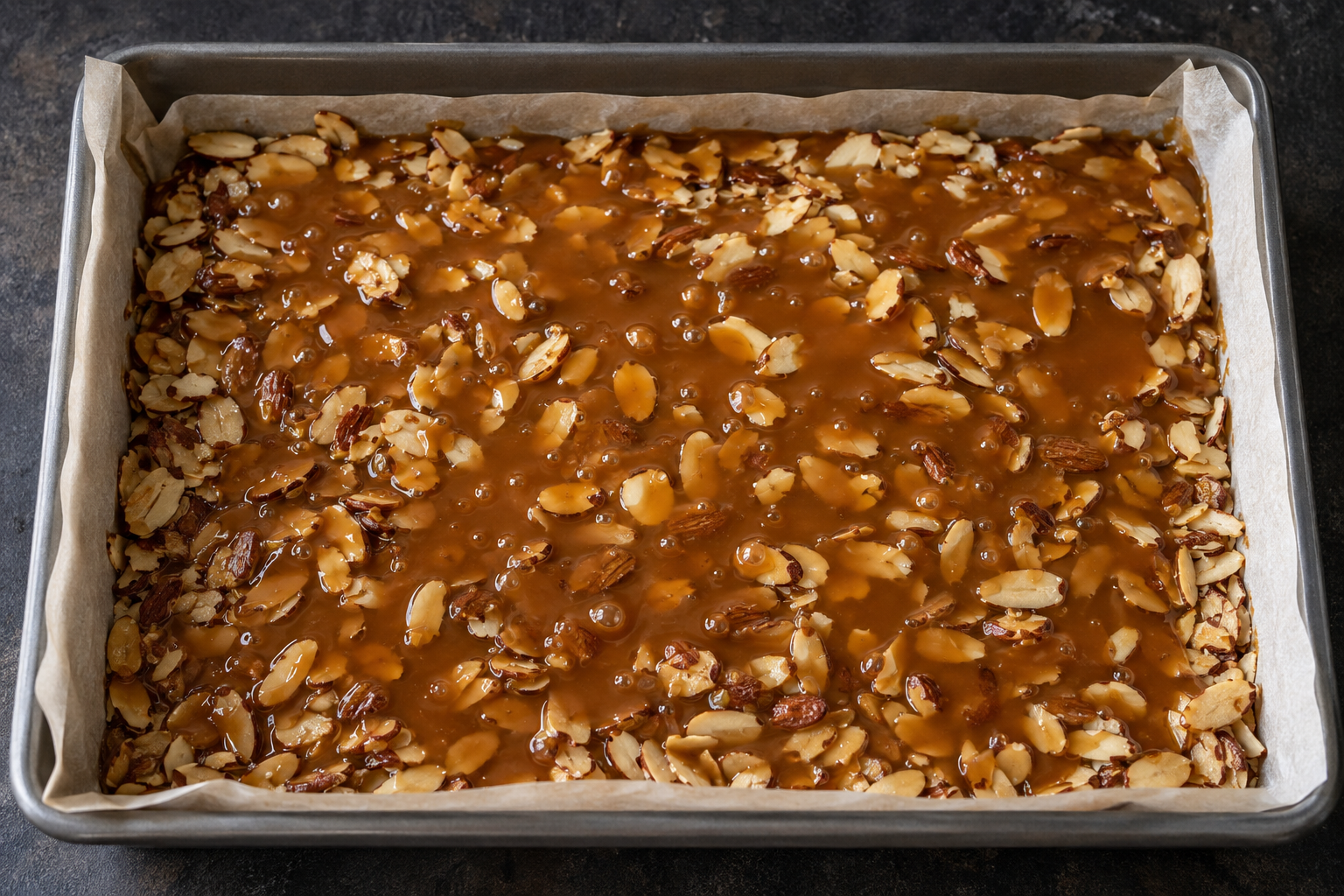
- Cool until matte: pour into the lined pan and let it cool undisturbed until it looks less fluid.
- Spread dark chocolate: cover the toffee, then pause briefly so it’s set but not fully hard.
- Pipe the spiderweb: draw spokes and pull lines from the center with white chocolate in a small bag.
- Set + slice: cool at room temperature at least 1 hour, then cut into pieces.
Ingredients guidance (so substitutions don’t surprise you)
- Almonds: toasted sliced almonds add that “dark chocolate almond” aroma. Optional, but recommended.
- Dark chocolate: look for chips or chopped chocolate in the ~60–72% cocoa range for a clean snap and strong contrast.
- White chocolate: use white chocolate chips so the web lines stay opaque and bright.
- Corn syrup: helps the toffee set smoothly. A swap to light golden syrup can work, but texture may vary.
Troubleshooting (based on visual cues)
- Toffee crystallizes or looks gritty: you likely stirred after boiling began. Starting agitation is fine, but once it’s boiling, stop stirring.
- Toffee won’t harden after cooling: it may not have reached 300°F / 149°C. Next time, wait for the thermometer to hit target.
- Dark chocolate smears when you draw the web: it’s too soft. Let it sit 2–5 minutes, then try again.
- White web snaps into blobs: it’s setting too fast. Wait 1–2 minutes and keep going; if your kitchen is very cool, warm the piping bag slightly in your hands.
- Sticky or softened pieces during storage: keep it dry and airtight. Skip refrigeration to prevent condensation.
Storage (humidity-safe, room-temp friendly)
Cool completely before storing. Keep in an airtight container at room temperature in a cool, dry spot. Avoid the fridge—condensation can soften toffee and dull the chocolate and web.
- If stacking, add parchment between layers.
- For party prep in humid weather, a small food-safe desiccant packet can help.
- Best quality target: up to about 2 weeks if your kitchen stays dry.
FAQ
Can I make it ahead for a Halloween gathering?
Yes. Make it up to about 2 weeks ahead if stored dry and airtight. For gift trays, slice fully once the slab is firm, then pack in layers with parchment.
Do I need a candy thermometer?
I strongly recommend one. This recipe relies on the exact cooked stage at 300°F / 149°C for crisp brittle.
Why is the timing of the spiderweb important?
The dark chocolate layer must be set enough to hold the lines cleanly, but still slightly workable so the white chocolate can “flow” into crisp web strokes without tearing.
Will the web design look perfect every time?
Not every line has to be identical. The spiderweb effect reads clearly as long as you have a center dot, a few spokes, and radial pulls outward.
Print
Halloween Spiderweb Dark Chocolate Almond Toffee (9×13)
- Prep Time: 15 minutes
- Cook Time: 20 minutes
- Total Time: 1 hour 35 minutes
- Yield: 1 slab in a 9×13 in (23×33 cm) pan; about 32 pieces
- Category: Chocolate Recipes
- Method: Candy-making / thermometer-cooked toffee + chocolate piping
- Cuisine: American
- Diet: Vegetarian
Description
A crisp, thermometer-cooked butter–almond toffee slab topped with dark chocolate and finished with an easy white-chocolate spiderweb drawn while the chocolate is still workable.
Ingredients
- 1 cup (227 g) unsalted butter
- 3/4 cup (150 g) granulated sugar
- 1/4 cup (60 ml) light corn syrup
- 1/2 cup (120 ml) water
- 1/2 tsp fine salt
- 1 tsp vanilla extract (optional; add at the end)
- 1 cup (120 g) sliced almonds, lightly toasted (optional but recommended)
- 10 oz (283 g) dark chocolate chips or chopped dark chocolate, divided
- 1/2 cup (85 g) white chocolate chips (for the web)
Instructions
- Prep the pan: Line a 9×13 in (23×33 cm) pan with parchment, leaving overhang. Set aside.
- Toast almonds (optional but recommended): Bake almonds at 325°F / 163°C for 8–10 minutes. Cool, then scatter them evenly across the parchment-lined pan.
- Cook the toffee: In a heavy saucepan, combine butter, sugar, corn syrup, water, and salt. Cook over medium heat, stirring slowly and continuously with a heatproof spatula and scraping the bottom and corners, until the mixture reaches 300°F / 149°C on a candy thermometer and turns deep amber. Remove from the heat; after the bubbling settles for about 10 seconds, carefully stir in the optional vanilla while keeping your face and hands back from the steam.
- Pour and set: Immediately pour the hot toffee over the toasted almonds in the lined pan and spread only if needed. Let it cool undisturbed until the surface looks matte and not fluid (usually 15–20 minutes, depending on your kitchen).
- Cover with dark chocolate: Melt about 2/3 of the dark chocolate. Pour and spread evenly over the toffee. Melt the remaining dark chocolate if needed to fully cover. Let sit 5–10 minutes until the top is set but still slightly pliable (it should not smear off easily if you drag a fork lightly).
- Pipe the spiderweb: Melt white chocolate. Transfer to a small zip-top bag; snip a tiny corner. Pipe 4–5 thin concentric circles, starting near the center and working outward. Before either chocolate sets, drag a clean toothpick from the center to the outside edge at 8 evenly spaced points to create the web. Wipe the toothpick after every drag; gently rewarm the white chocolate if it becomes too thick to pipe.
- Set completely: Let harden at room temperature for at least 1 hour.
- Lift and slice: Lift out using parchment overhang and slice with a sharp knife into about 32 pieces.
Notes
Hot caramel can cause severe burns—use caution and keep the thermometer clipped securely. Don’t scrape cooked toffee with water (splatter risk). If dark chocolate is too soft, wait a few minutes before drawing the web.