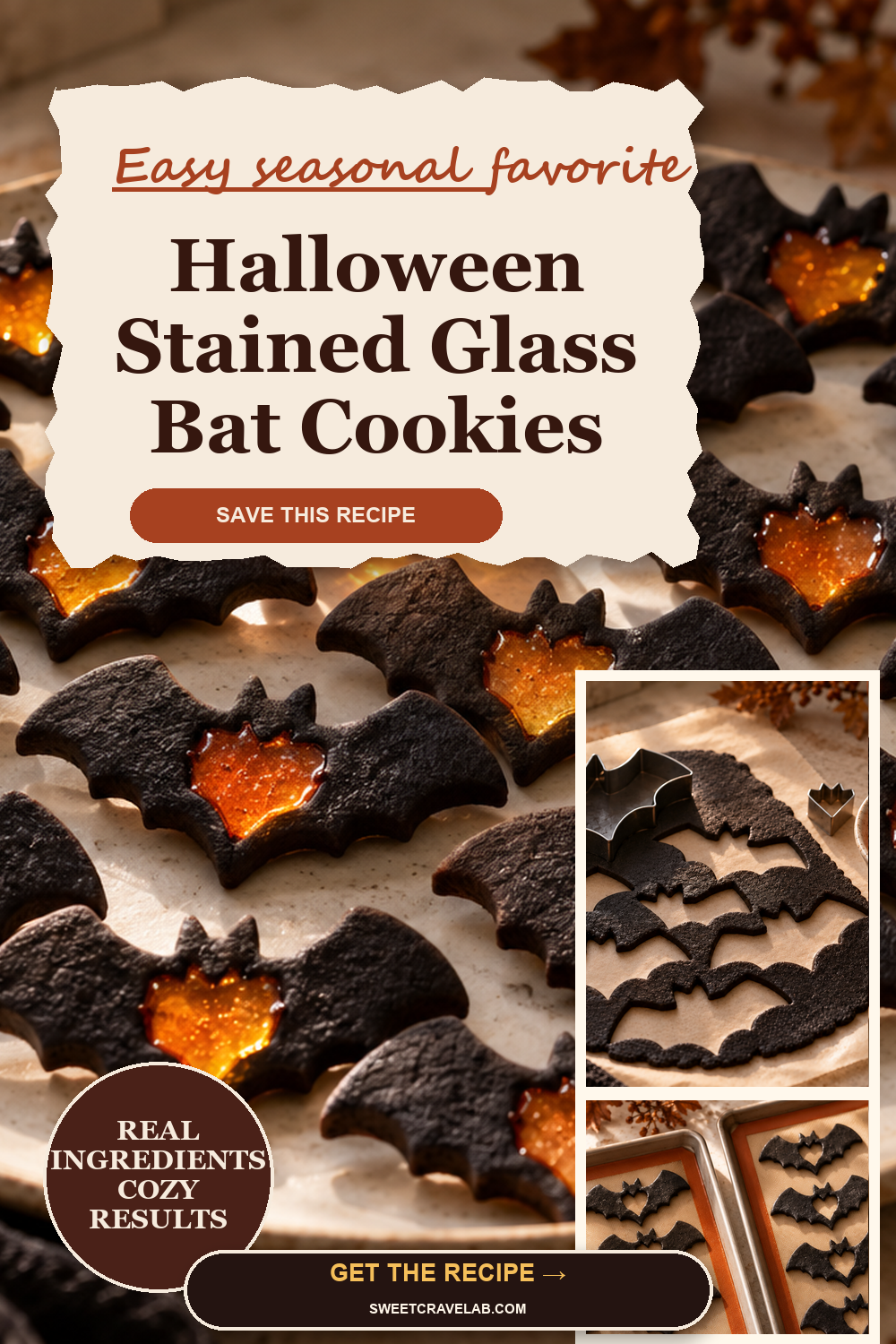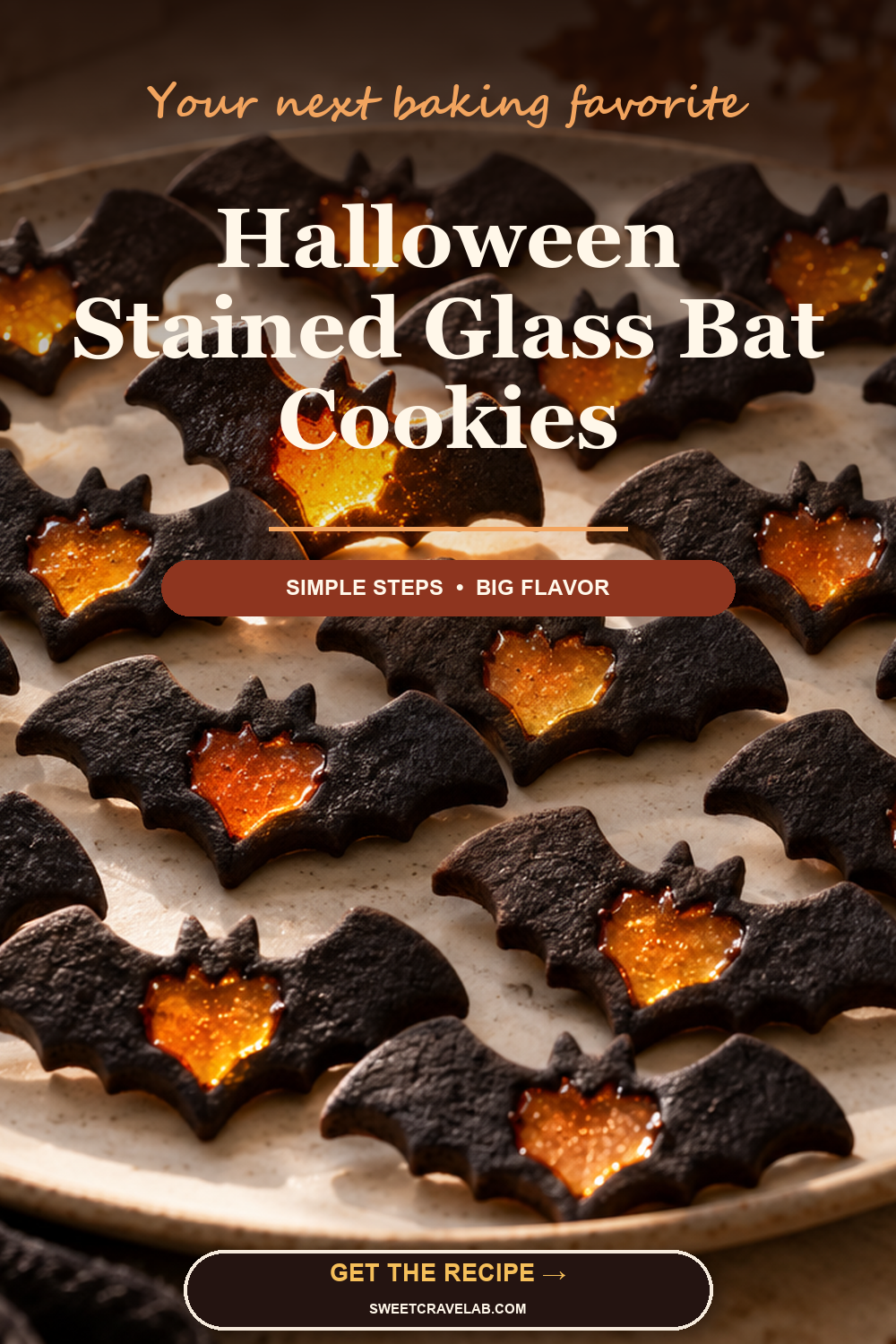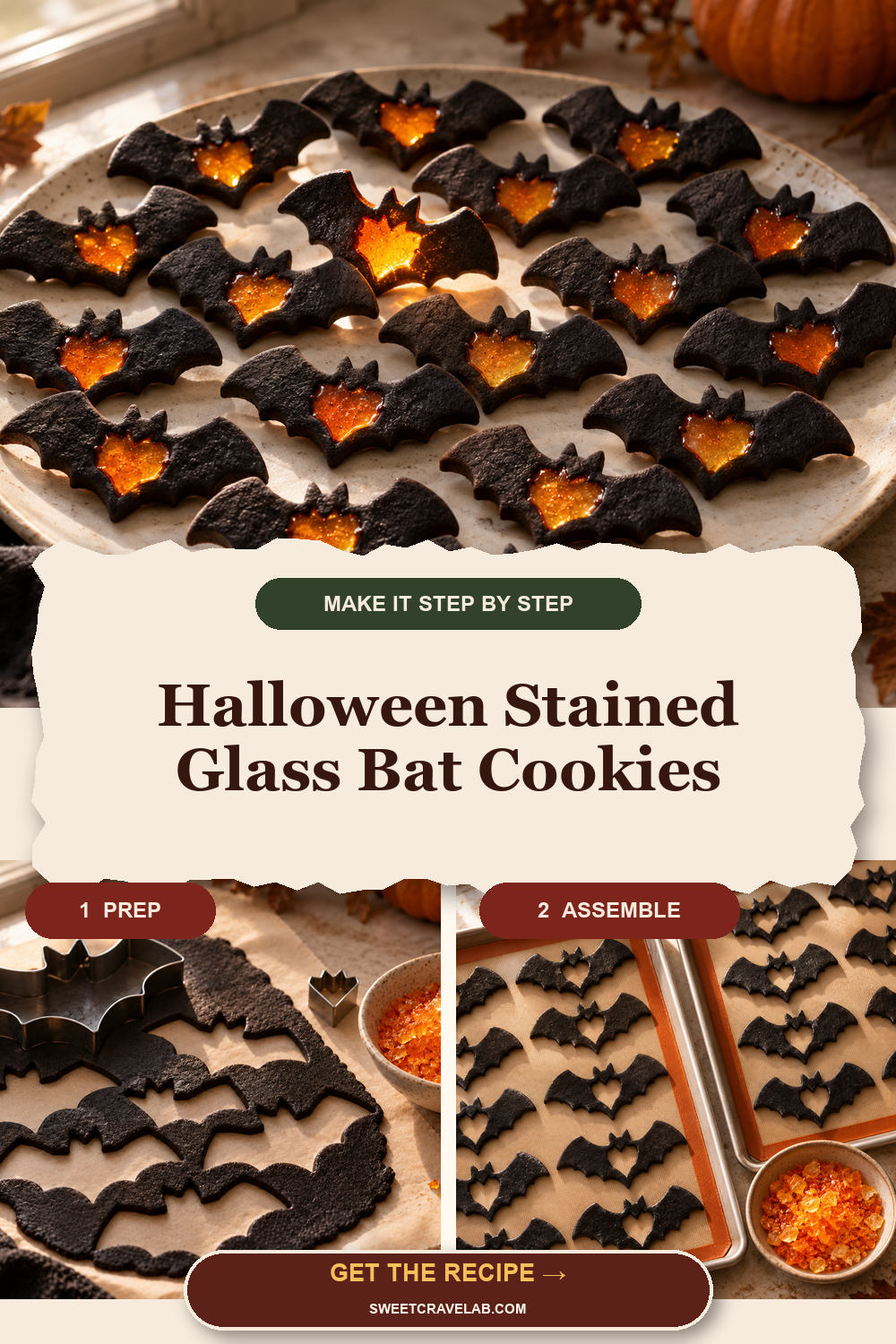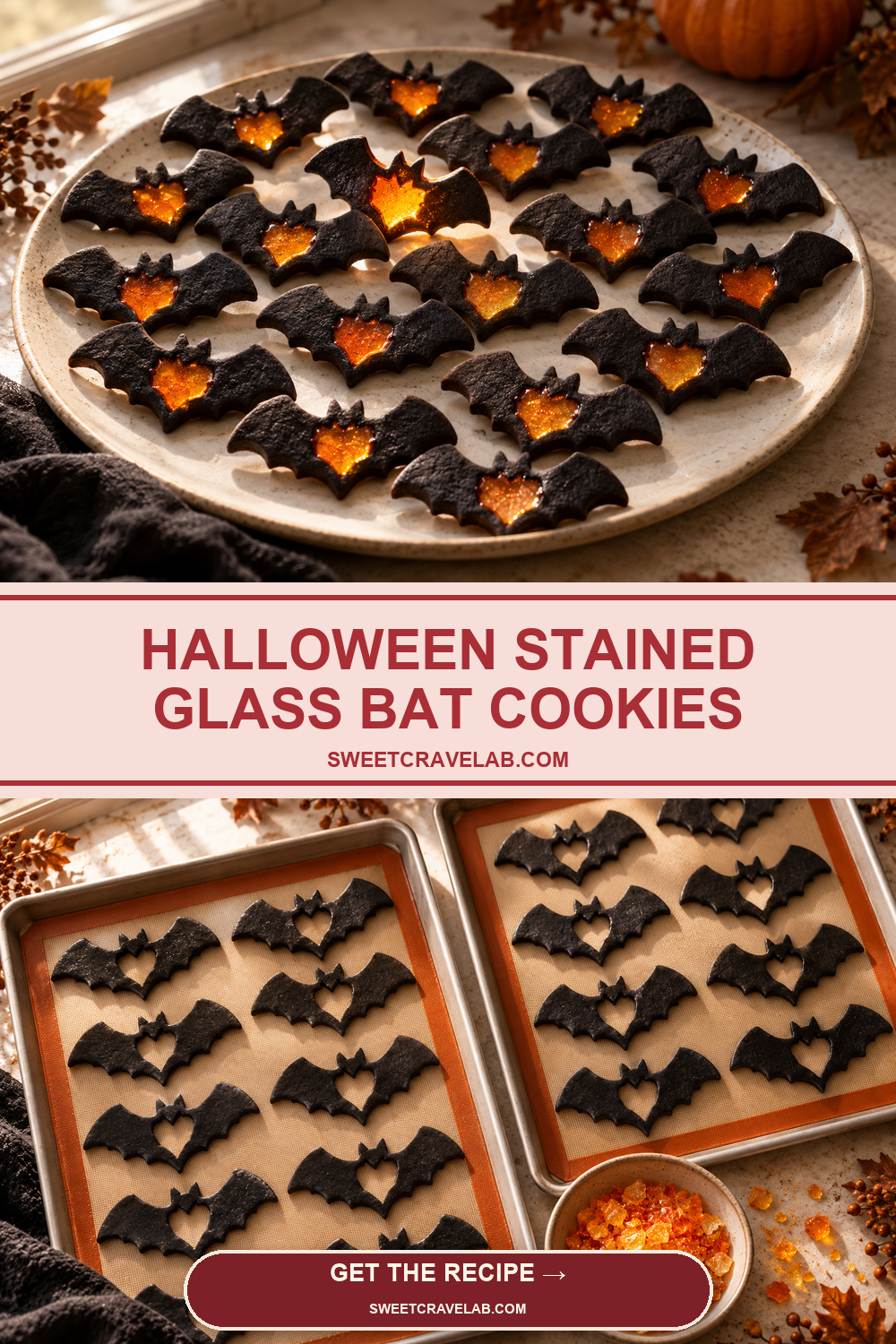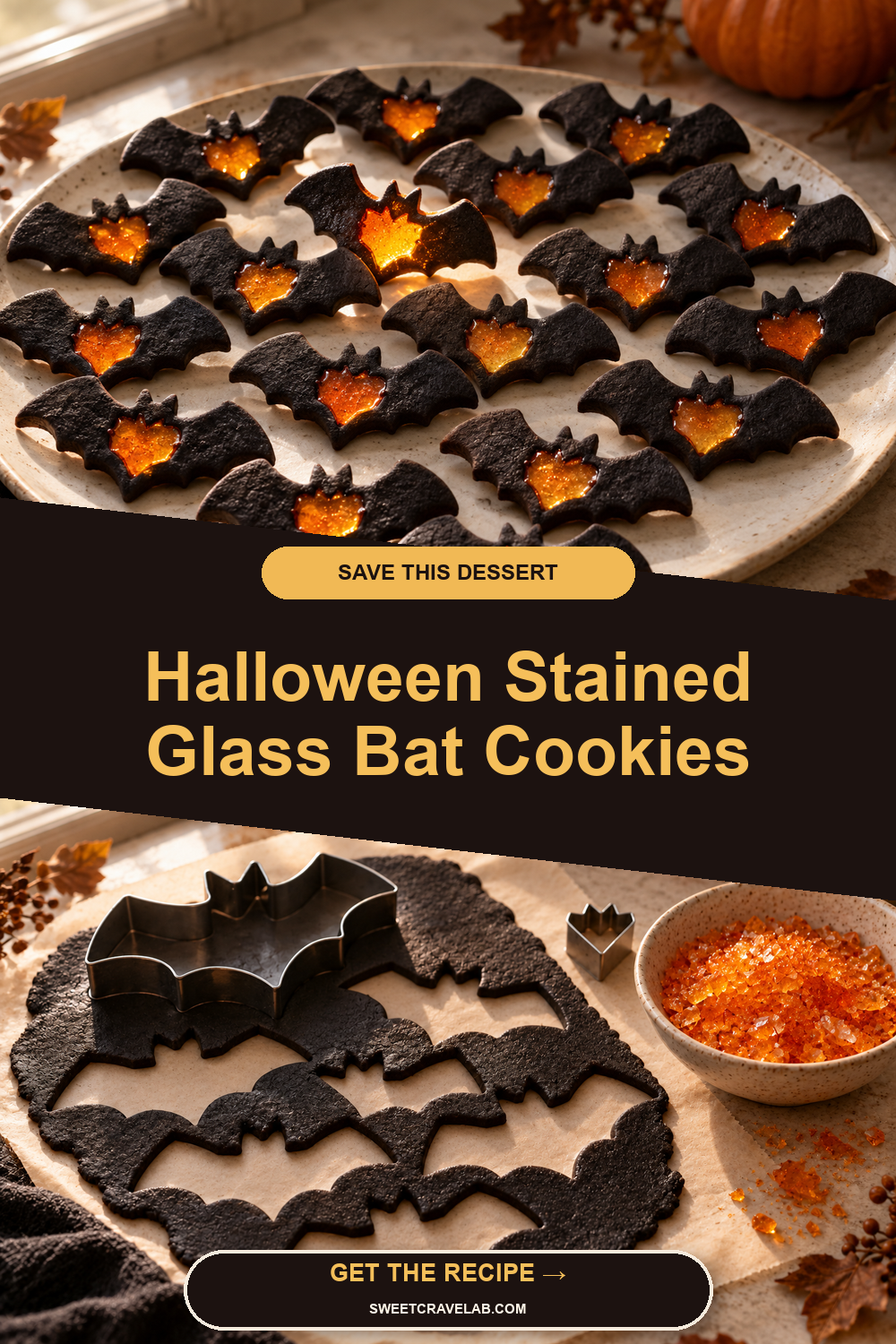
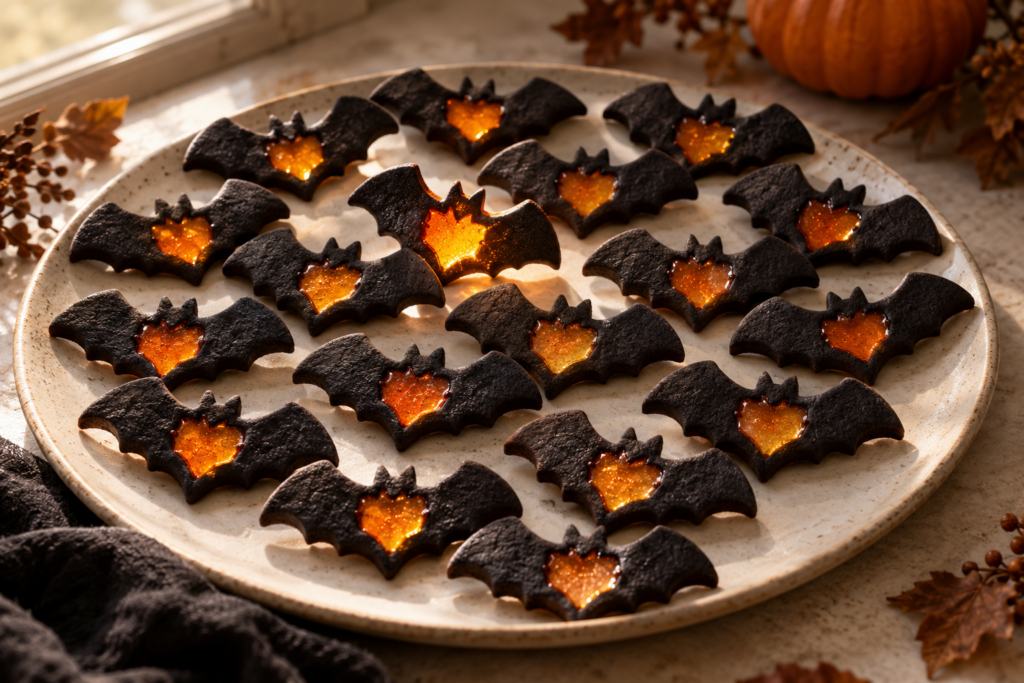
Halloween stained glass bat cookies combine crisp black cocoa shortbread with translucent orange candy centers that glow when held near a window. The shape is unmistakably seasonal, yet the decoration comes from the structure of the cookie itself rather than thick royal icing or a crowded mix of toppings.
Stained-glass cookies require a little precision, but the process is straightforward when dough temperature, candy texture, and bake time are controlled. The shortbread is rolled between parchment for an even surface, chilled before cutting, and baked on silicone so the molten candy releases without sticking.
In this guide
Why Halloween stained glass bat cookies work
A shortbread-style dough holds sharp points better than a soft drop-cookie formula. Powdered sugar dissolves quickly and contains a little starch, helping the crumb stay fine. One egg provides enough binding to lift narrow wings while a small amount of cornstarch limits spread around the candy window.
Black cocoa gives the bats their dramatic color without a large quantity of food coloring. Because it is highly alkalized and mild, Dutch-process cocoa is included for fuller chocolate flavor. Orange hard candy creates a high-contrast window and melts into a flat sheet as long as the pieces are crushed evenly.
For Halloween stained glass bat cookies with clear centers, the candy must be added in a shallow, level layer. Too little leaves holes; too much boils over the cutout and stains the dark dough. Baking the empty shapes briefly before filling helps the cookie edges set while reducing the candy’s exposure to heat.
Ingredient notes for reliable results
Use cool, pliable butter
Butter should accept a fingertip without looking shiny or oily. Very soft butter holds extra air during mixing and encourages spread. Beat only until the powdered sugar disappears rather than whipping for maximum volume, because sharp bat wings depend on a compact dough.
Crush clear hard candy by color
Choose translucent orange hard candies without creamy or chewy centers. Unwrap them, seal them inside two sturdy bags, and crush to small gravel rather than powder. Uniform pieces melt at a similar rate and trap fewer opaque bubbles.
Roll to a true quarter inch
Thin wings burn before the candy melts, while thick cookies stay soft around the window. Rolling guides make the full sheet consistent. Chill the rolled dough before cutting so the cutter releases cleanly and the inner window remains centered.
How to make Halloween stained glass bat cookies
Cream cool butter with powdered sugar just until smooth, then mix in the egg and vanilla. Whisk flour, both cocoas, cornstarch, and salt separately. Add the dry mixture on low speed until moist clumps form, then press the dough together by hand without prolonged kneading.
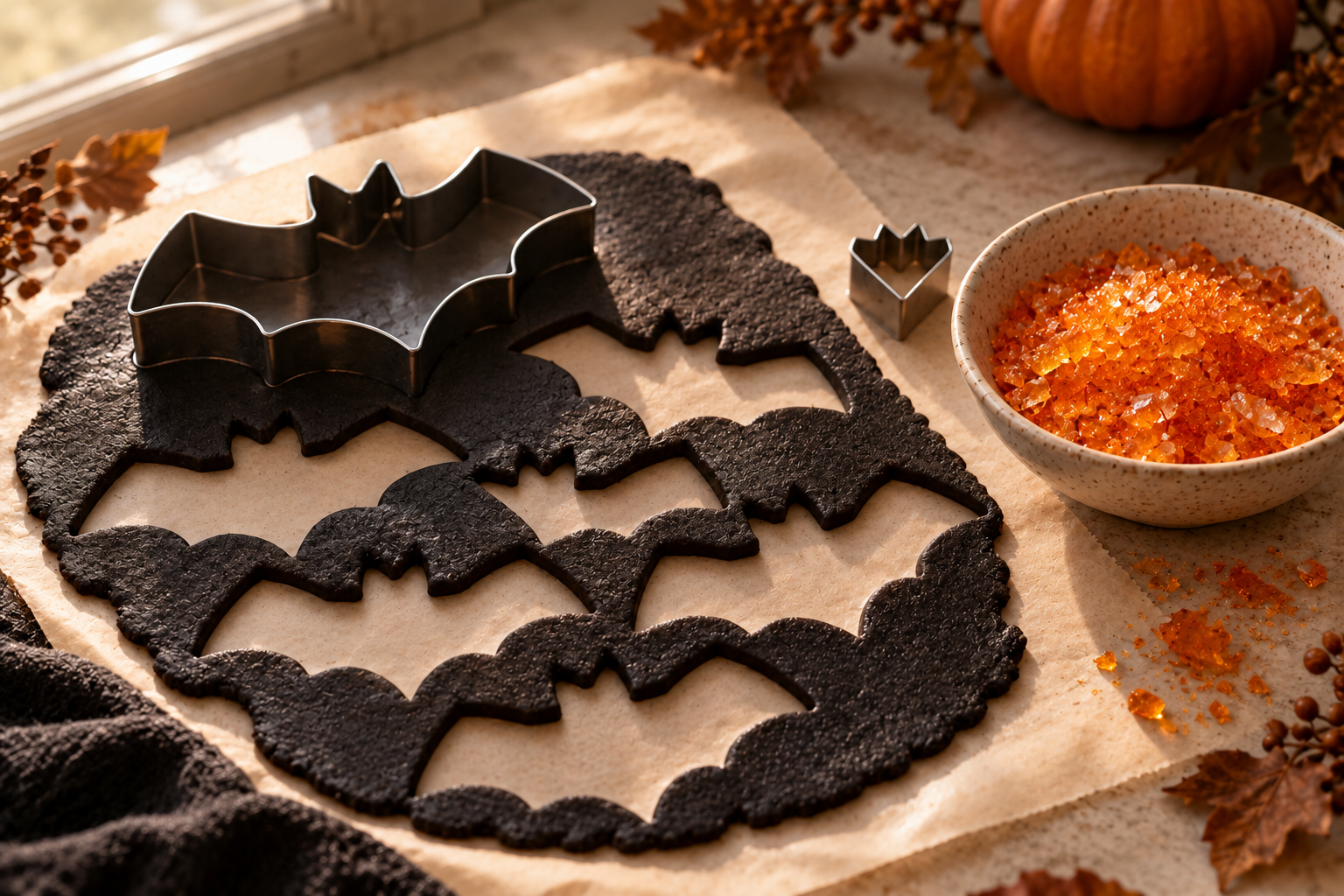
Divide the dough and roll each portion between parchment to one-quarter inch. Chill the sheets flat, peel away the top paper, and cut large bat shapes. Use a small diamond, oval, or teardrop cutter to remove one window from the center of each body, leaving a sturdy border around it.
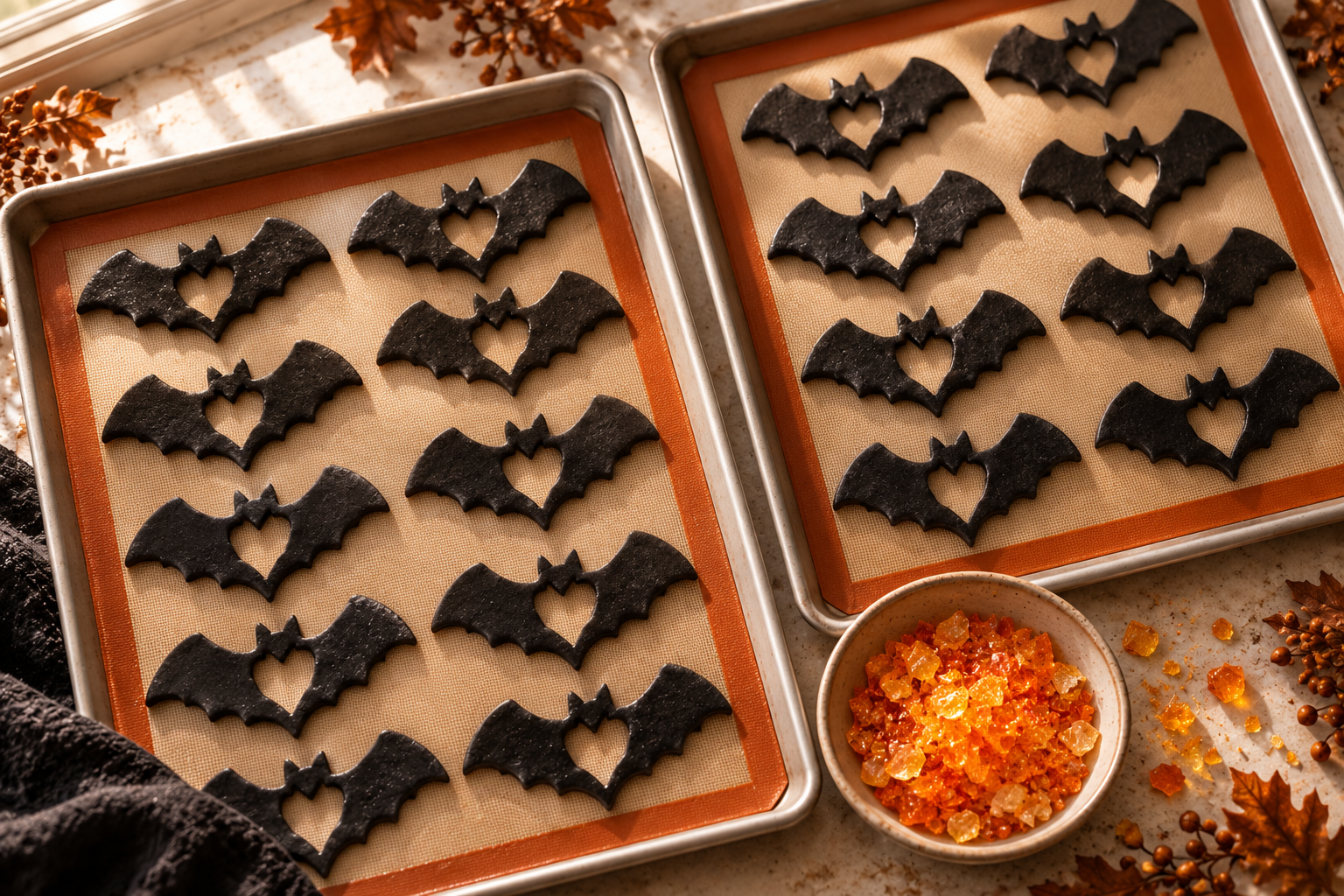
Transfer shapes to silicone-lined light metal sheets and chill again. Bake briefly until the surface loses its raw sheen, pull the tray forward carefully, and spoon an even layer of orange candy gravel into each opening. Keep the candy below the top edge of the dough.
Return the tray to the oven until the cookie edges are set and the candy has melted into one flat pool. Let Halloween stained glass bat cookies cool completely on the sheet. The candy is dangerously hot while liquid and also needs time to harden before it can release from the silicone mat.
Visual cues for Halloween stained glass bat cookies
The dough should remain matte and hold each pointed wing after transfer. If an edge bends, the sheet is too warm; refrigerate it before baking. The candy window is ready when individual pieces disappear into one level orange pool with only a few small bubbles.
Finished cookies feel firm around the outside but not rock hard. The black cocoa edge may not show obvious browning, so rely on a dry surface and set underside. Halloween stained glass bat cookies release cleanly only after the orange window becomes fully rigid and cool.
Troubleshooting Halloween stained glass bat cookies
Why did the bat shapes spread?
The butter or cut dough was too warm, the butter was over-creamed, or flour was under-measured. Weigh dry ingredients, mix only until smooth, and chill the cut tray for at least 15 minutes before it enters the oven.
Why is the candy cloudy or bubbly?
Candy crushed to powder traps air and overheats quickly. Use small gravel, spread it evenly, and remove the tray as soon as the pools become level. A few bubbles are natural and add handmade character.
Why did the windows crack?
Very thick candy centers, rapid temperature changes, or stacking without padding can cause fractures. Fill shallowly, cool at room temperature, and store the cookies in one layer or with parchment between flat layers.
Make-ahead and storage for Halloween stained glass bat cookies
Prepare and refrigerate the dough for up to three days, or freeze rolled sheets for one month. Let frozen sheets soften only enough for the cutter to pass through. Candy can be crushed several days ahead and stored airtight by color away from humidity.
Keep baked Halloween stained glass bat cookies airtight at cool room temperature for up to five days. Add a food-safe silica packet to the container if the climate is humid, making sure it cannot touch the cookies. Humidity makes the orange centers sticky and dull.
Serve them with black cocoa moon crinkles, or explore the cookie collection. King Arthur’s cookie guide provides useful general advice on pan choice, measuring, and controlling spread.
Halloween stained glass bat cookies frequently asked questions
Can I use another cookie shape?
Yes. Pumpkins, cats, moons, and simple ghosts work if the outline has enough dough around the inner window. Avoid extremely narrow details that can break when the candy releases.
Can I bake on parchment instead of silicone?
Good-quality parchment can work, but candy releases most reliably from a silicone baking mat. Test one cookie first because thin parchment coatings vary and may bond to the sugar.
Can I make the windows purple?
Yes. Use translucent purple hard candy and keep the black dough unchanged. A mix of colors in one opening can become muddy, so fill each window with a single coordinated color.
How many Halloween stained glass bat cookies does this make?
The recipe makes about 18 large bats when the dough is rolled one-quarter inch thick. Yield varies with cutter size and the amount rerolled from between the wings.
Print
Halloween Stained Glass Bat Cookies
- Prep Time: 45 minutes
- Cook Time: 26 minutes
- Total Time: 2 hours 15 minutes
- Yield: 18 cookies
- Category: Dessert
- Method: Baking
- Cuisine: American
- Diet: Vegetarian
Description
Crisp black cocoa bat shortbread with translucent orange hard-candy windows.
Ingredients
- 1 cup (226 g) unsalted butter, cool and pliable
- 1 cup (120 g) powdered sugar
- 1 large egg (50 g without shell), room temperature
- 2 tsp (10 ml) vanilla extract
- 2 cups (250 g) all-purpose flour
- 1/3 cup (28 g) black cocoa powder
- 2 tbsp (11 g) Dutch-process cocoa powder
- 2 tbsp (16 g) cornstarch
- 1/2 tsp fine salt
- 5 oz (142 g) translucent orange hard candies, unwrapped and crushed
Instructions
- Beat butter and powdered sugar just until smooth. Mix in the egg and vanilla.
- Whisk flour, both cocoas, cornstarch, and salt. Mix into the butter on low until moist clumps form.
- Divide and roll between parchment to 1/4 inch (6 mm). Chill flat for 45 minutes.
- Cut 18 large bats and remove one small centered window from each body. Arrange on silicone-lined light metal sheets and chill 15 minutes.
- Heat the oven to 350°F (175°C). Bake one tray for 5 minutes.
- Carefully fill each opening with an even shallow layer of crushed orange candy.
- Return to the oven for 6-8 minutes, until the candy forms a flat pool and cookie surfaces look dry.
- Cool completely on the silicone mat before lifting. Repeat with the second tray.
Notes
Use candy gravel rather than powder, keep the dough cold, and never touch the molten centers until they are fully cool and hard.